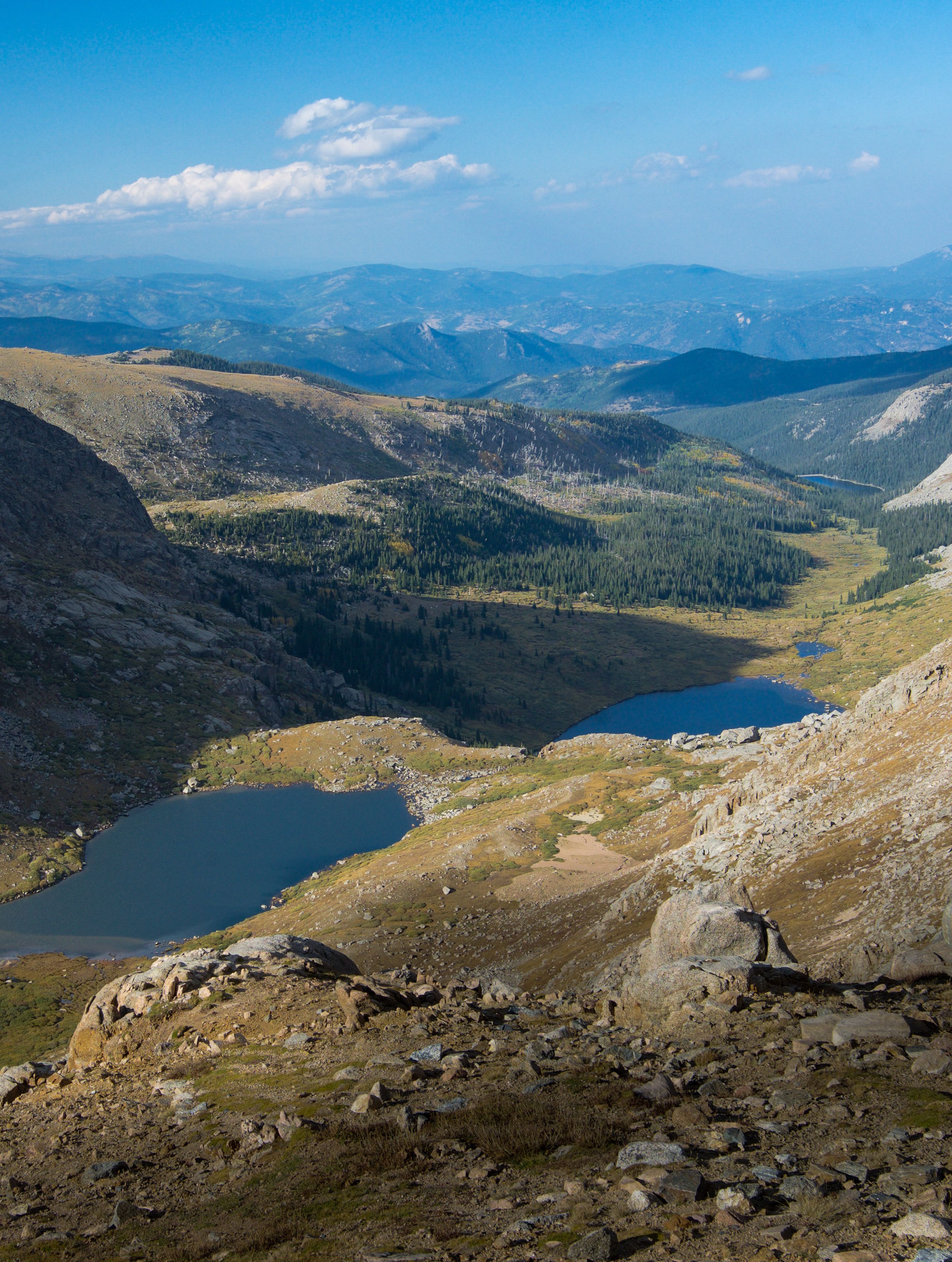
Rocky Mountain National Park
Estes Park & Grand Lake
Alpine tundra, 355 miles of trail, and the headwaters of the Colorado River. Trail Ridge Road crosses above 12,000 feet.
Timed entry reservation required May 22 – mid-October.
Colorado What's Up›Things To Do In Colorado
Thirty-three real places, filterable by region, season, effort and cost — plus the 2026 permit and reservation rules that turn people around at the gate.
What are the best things to do in Colorado?
The four national parks — Rocky Mountain, Mesa Verde, Great Sand Dunes and Black Canyon of the Gunnison — are the anchors. Beyond them, Colorado's signature experiences are scenic driving on 26 designated byways, soaking in natural hot springs, hiking among 58 peaks above 14,000 feet, skiing from December through March, and stargazing in one of 13 International Dark Sky Parks. Denver adds immersive art, world-class museums and dinosaur fossils twenty minutes from downtown.
There is no shortage of Colorado lists. What there is a shortage of is lists that tell you the thing that actually ruins trips: half the best places now require a reservation you needed to book weeks ago.
So this page does two jobs. First, a filterable index of thirty-two places worth your time, sorted by where they are and when they are good. Second, a plain table of what currently requires a permit, what it costs, and when the window closes — verified for the 2026 season rather than copied from an older guide.
Colorado is bigger than people expect. Denver to Durango is roughly six and a half hours. Denver to the Great Sand Dunes is four. You cannot do the state in a long weekend, and the fastest way to have a bad trip here is to plan one that treats the map like it is the size of Vermont. Pick a region. Go deep.
The index — 33 places
Every place below is somewhere you can actually go. Filter by region if you have already picked a corner of the state, by season if you have already picked a month, or by cost if the budget is the constraint. Everything stays on the page — nothing loads in.
Estes Park & Grand Lake
Alpine tundra, 355 miles of trail, and the headwaters of the Colorado River. Trail Ridge Road crosses above 12,000 feet.
Timed entry reservation required May 22 – mid-October.
Colorado Springs
Vertical red sandstone fins pushed upright by the same uplift that raised Pikes Peak. Paved trails, and free forever by deed.
Mosca, San Luis Valley
The tallest dunes in North America, roughly 750 feet, piled against the Sangre de Cristo range. Rent a sandboard in Alamosa.
Sand surface can exceed 150°F on summer afternoons. Go early or late.
Cortez
Roughly 5,000 archaeological sites including some 600 Ancestral Puebloan cliff dwellings. Cliff Palace needs a ranger-led ticket.
Montrose
A gorge so narrow and deep that parts of the inner canyon get roughly half an hour of direct sun a day.
Morrison
A concert venue wedged between 300-foot sandstone monoliths. Free to walk any day nothing is scheduled; locals run the stairs at sunrise.
Denver
Four floors of immersive art by hundreds of artists, wrapped around a science fiction narrative. Plan three hours and buy ahead.
Denver
Two buildings that argue with each other — Gio Ponti's 1971 tower and Libeskind's angular 2006 addition. Major Indigenous Arts collection.
Denver
Holds roughly 95% of one major Abstract Expressionist's entire life output. Nothing else like it exists for any painter of his stature.
Denver
Serious paleontology and anthropology plus the Gates Planetarium, with a full Front Range view from the west windows.
Morrison
Jurassic bones on one side of the ridge, hundreds of Cretaceous footprints on the other. Walking the road is free; the bus tour is not.
Boulder
I.M. Pei designed it after studying Mesa Verde. Free exhibit floor on atmospheric science, free parking, trails leaving from the lot.
Colorado Springs
14,115 feet by cog railway, highway or a very long hike. Katharine Lee Bates wrote 'America the Beautiful' after reaching this summit in 1893.
Rocky Mountain NP
The highest continuous paved road in any U.S. national park, crossing eleven miles above treeline.
Typically closed by snow late October through late May.
Idaho Springs
The highest paved road in North America — over 7,000 feet of climb in 28 miles. Mountain goats and bighorn sheep are routine.
Reopened Memorial Day weekend 2026. Timed entry now run by Denver Mountain Parks.
Durango–Silverton–Ouray
A 236-mile loop through the most dramatic mountains in Colorado, including the Million Dollar Highway. Best fall color drive in the state.
Crested Butte
Thirty miles of dirt road through what may be the largest contiguous aspen forest in North America. Passable in a regular car when dry.
Aspen
The most photographed mountains in North America. Two 14,000-foot peaks reflected in Maroon Lake, ringed by aspen.
Vehicle or shuttle reservation required May 15 – Oct 31.
Glenwood Canyon
A turquoise travertine lake suspended on a cliff face, fed by Bridal Veil Falls. 1.2 miles up, about 1,200 feet of gain.
Permit required year-round. Trailhead is I-70 Exit 125, eastbound access only.
Glenwood Springs
One of the largest geothermal pools anywhere, right off I-70. The reliable answer when the weather ruins the rest of the plan.
Steamboat Springs
Stone-terraced natural pools in a creek canyon outside town. The winter road frequently requires four-wheel drive or a shuttle.
Salida & Buena Vista
The most-rafted river in the country, with everything from float trips to Class IV in Browns Canyon.
Low snow years shorten the big-water window — ask what the gauge is reading.
Vail, Aspen, Breckenridge, Steamboat
The reason a lot of people know Colorado exists. Buy the multi-resort pass in spring for the following season, not in December.
Statewide national forests
The cheap version of winter here. Rent snowshoes for the price of a lift ticket lunch and have a drainage entirely to yourself.
Estes Park
September and October, dawn and dusk. Hundreds of elk bugling in the meadows. Watch from the car and keep your distance.
Cañon City
A suspension bridge hanging 956 feet above the Arkansas River, for decades the highest in the world.
Rye
A full stone castle with towers, iron catwalks and a dragon, built almost single-handedly by Jim Bishop starting in 1969. No admission.
Durango
A coal-fired steam train running an 1882 narrow-gauge route through the Animas River canyon. All day, and worth it.
Fruita & Grand Junction
Twenty-three miles of rim road above red rock canyons and freestanding monoliths. Stunning and almost never crowded.
San Luis Valley & statewide
Colorado has 13 International Dark Sky Parks and eight Dark Sky Communities — more certified places in progress than anywhere on Earth.
Go near a new moon and give your eyes 30 minutes to adapt.
La Junta
The largest dinosaur tracksite in North America — hundreds of prints in a remote canyon floor. Long, hot, waterless approach.
No shade and no water. Not a summer trip.
La Junta
A full reconstruction of an 1830s adobe trading post on the Santa Fe Trail, staffed in period. The best history stop on the plains.
Calhan
Banded clay hoodoos and spires that look like southern Utah dropped onto the Colorado prairie. Free, and almost nobody is there.
No places match all of those filters. Try clearing one.

Costs are rough per-person day rates and exclude lodging, gas and gear rental. "Free" means no entrance or permit fee at time of writing. Fees change — the reservation table below carries the ones we verified for 2026.
Orientation
What are the different regions of Colorado?
Colorado divides into five practical travel regions: the Front Range urban corridor along I-25, the High Country of the central Rockies, the Western Slope beyond the Continental Divide, the San Luis Valley in the south-central basin, and the Eastern Plains. They differ by hours of driving, thousands of feet of elevation and entire ecosystems. Choosing one is the single most useful planning decision you can make.
01 · I-25 corridor
Denver, Boulder, Colorado Springs, Fort Collins. Where 80% of the population lives. Museums, food, breweries, red rock, and foothills trailheads thirty minutes from downtown.
02 · I-70 west
Summit County, Vail, Aspen, Leadville, Estes Park. The ski resorts, the fourteeners, Rocky Mountain National Park. Highest average elevation and the shortest summer.
03 · Beyond the Divide
Grand Junction, Durango, Telluride, Ouray, Mesa Verde. Desert canyon country meeting the San Juans. Warmer, drier, emptier, and the best fall color in the state.
04 · South-central basin
Alamosa, Great Sand Dunes, Crestone. A high desert basin ringed by 14,000-foot peaks. Strange, quiet, and one of the darkest night skies in the lower 48.
05 · East of I-25
La Junta, Sterling, Lamar. Almost nobody goes. Which is why the dinosaur tracks, the adobe forts and the sandstone hoodoos out here are still yours alone.
The mistake first-time visitors make is trying to touch three of these in five days. Denver to Durango is about six and a half hours of driving each way, and much of it is mountain highway where you cannot make up time. Grand Junction to the Great Sand Dunes is another four. Colorado is roughly the same size as the entire United Kingdom, and it has mountains in the middle of it.
A better plan: pick the region that matches your season. High Country in July and September. Western Slope in May, June and October. Front Range and Eastern Plains any time. San Luis Valley in late spring or fall, when the dunes are not 150 degrees on the surface.
The part other guides get wrong
Do you need reservations for Colorado attractions?
For several of the most popular ones, yes. Rocky Mountain National Park, the Maroon Bells, Hanging Lake and Mount Blue Sky all require advance reservations during their operating seasons, and all of them regularly sell out. Showing up without one is the most common way visitors get turned around at the gate.
This is the section that goes stale fastest, so here is what we verified for the 2026 season as of August. Confirm before you travel — these systems change year to year, and 2026 already brought one significant handover.
| Place | 2026 window | Cost | What to know |
|---|---|---|---|
| Rocky Mountain National Park |
May 22 – Oct 13 (rest of park) May 22 – Oct 18 (Bear Lake Rd) |
$2 processing + park entry |
Two permit types. Bear Lake Rd covers 5 a.m.–6 p.m.; rest of park covers 9 a.m.–2 p.m. Two-hour entry windows, no departure time. Extra slots drop at 7 p.m. MT the night before — that is the one people miss. |
| Maroon Bells near Aspen |
Vehicle access May 15 – Oct 31 RFTA shuttle May 22 – Oct 18 |
Parking $10/vehicle Shuttle $16 adult |
Road is shuttle-only 8 a.m.–5 p.m., so drive before 8 or after 5. Shuttle runs from Aspen Highlands; garage parking is $8/hour, capped around $42 weekdays and $48 weekends. E-bikes now pay a $5 amenity fee because the Forest Service classifies them as motorized. |
| Hanging Lake Glenwood Canyon |
Permits available through December 2026 |
$12 May–Oct $10 Nov–Apr |
1.2 miles each way, about 1,200 feet of gain. Trailhead is at I-70 Exit 125, eastbound only — coming from Denver you pass it, take Exit 119, turn around and come back. Trail can close on short notice after heavy rain because of the burn scar; permits are refunded. |
| Mount Blue Sky Scenic Byway |
Reopened Memorial Day weekend 2026 |
Timed entry reservation + fee |
Open again after nearly two years of construction. Denver Mountain Parks now runs reservations and collects the fee — the Forest Service used to staff the entrance. Highest paved road in North America; climbs over 7,000 feet in 28 miles to about 14,130 feet. |
Sources: National Park Service 2026 timed entry announcement; White River National Forest and Aspen Chamber Resort Association; Visit Glenwood Springs and Colorado Tourism Office; Colorado Department of Transportation and Denver Mountain Parks. Verified August 2026.
No ticket required
What can you do in Colorado for free?
Garden of the Gods, Red Rocks Amphitheatre outside of show hours, the NCAR Mesa Lab exhibit floor, Dinosaur Ridge's public road, RiNo's outdoor murals, Bishop Castle, Bent's Old Fort, Paint Mines Interpretive Park, every national forest trailhead, and stargazing anywhere in the San Luis Valley. Colorado's best-known free attraction, Garden of the Gods, was donated to Colorado Springs in 1909 on the condition that it remain free to the public forever.
The genuinely useful insight about free Colorado is that the state's public land is enormous. Eleven national forests cover a huge share of the mountains, and hiking on national forest land does not cost anything. The fees you run into are concentrated in a handful of famous places with parking problems.
If you skip those four or five bottlenecks, most of Colorado has no gate at all.
Timing
Colorado has four completely different tourism products depending on the month. Booking the wrong one is how people end up driving to a pass that is still under twelve feet of snow.
The awkward season, and the cheapest. High mountain passes are still closed, Trail Ridge Road has not opened, and the trails below 9,000 feet are mud. But the Western Slope is perfect — Colorado National Monument, Mesa Verde and the desert canyons are at their best before summer heat. Rafting season starts as runoff picks up. Hotel rates in mountain towns bottom out between ski season and summer.
In a drought year like 2026, spring runoff arrives earlier and drops off faster, so the big-water rafting window compresses. Ask the outfitter what the gauge is reading.
Everything is open and everyone is here. Trail Ridge Road, the high passes, the fourteeners, the alpine lakes. It is also the season with the most rules: this is when the reservation systems above are all running.
Two things to plan around. Afternoon thunderstorms build almost daily from mid-July into early September, so summit early and be below treeline by two. And July and August are peak wildfire and smoke season on the Western Slope, which can turn a clear forecast into a hazy one.
The best month in Colorado is September and it is not close. Stable weather, thinner crowds after Labor Day, the elk rut in Estes Park, and aspens.
Color runs by elevation, not by date. High passes above 10,000 feet peak mid to late September. Mid-elevation spots like Kenosha and Guanella pass late September into early October. The Front Range holds into mid-October. Drought pulls the whole sequence earlier and shortens it, which is happening this year.
Ski season, obviously — but the underrated winter Colorado is hot springs, Nordic skiing, snowshoeing and empty desert. Shelf Road near Cañon City has rock climbing in January. Colorado National Monument is quiet and gorgeous under snow. Mesa Verde stays open with far fewer people.
The constraint is driving. I-70 westbound on a Friday and eastbound on a Sunday during ski season is genuinely brutal, and CDOT activates traction and chain restrictions during storms. Check COtrip or dial 511 before you leave, not at the on-ramp.
Kids and bad weather
The altitude hits children harder and faster than adults, and it usually shows up as crankiness and a bad night's sleep rather than anything dramatic. Plan low for the first day.
Afternoon storms and early snow are normal here. A washed-out day is not a lost day.
The itinerary I hand people: Clyfford Still Museum in the morning, walk across the plaza to the Denver Art Museum after lunch, drive twenty minutes out to Dinosaur Ridge when the light on the track slab is best, finish at Red Rocks whether or not there is a show. Mostly indoors, costs less than a lift ticket, and covers Abstract Expressionism, a Gio Ponti building, the Jurassic and 300-foot sandstone monoliths.
Outside Denver, the reliable bad-weather answer is hot springs. Glenwood, Steamboat's Strawberry Park, Ouray, Pagosa. Sitting in 104-degree mineral water while it snows on your head is arguably the best thing about winter in this state.
If you did not come here on vacation
What can you do in Denver with only a few hours?
From the Colorado Convention Center, the Denver Art Museum, Clyfford Still Museum and History Colorado Center are all a walk of roughly ten to fifteen minutes. With two hours, do one museum. With four, add Union Station and Larimer Square. With a full free afternoon, drive thirty minutes to Red Rocks Amphitheatre — it is free to walk and it is the best thing within an hour of downtown.
Denver runs a serious convention calendar, which means a large share of the people reading this page did not choose Colorado — a sales kickoff, a trade show or a client meeting did. That is still a real trip, and downtown Denver is unusually good for it because the cultural district is genuinely walkable from the convention hotels.
Pick one museum and commit. The Clyfford Still is small enough to do properly in ninety minutes and it is the most unusual collection in the American West. The Denver Art Museum needs longer, but the Indigenous Arts of North America galleries alone justify a short visit.
Union Station for coffee in the great hall, walk the 16th Street corridor, then Larimer Square. If you have a car or do not mind a short rideshare, RiNo is an outdoor mural district that repaints itself annually — free, walkable, different every year.
Red Rocks in the morning, Dinosaur Ridge on the way back, and you are showered and back downtown before dinner. Or Meow Wolf Convergence Station if the weather is bad and you want the strangest three hours available in the state.
And if you are here running the meeting rather than attending it — the difference between a good week in Denver and an expensive one usually comes down to what happens in the room, not what happens after it. Structured sales training is the unglamorous version of preparation, and it is the one that changes the number at the end of the quarter.
The other two questions
Two things determine whether a Colorado trip felt good in hindsight, and neither of them is the hike.
Denver's restaurant scene stopped being a punchline about fifteen years ago and has been quietly excellent since. The concentration is in RiNo, LoHi and the Highlands rather than downtown proper. Green chile is the regional dish that actually matters here, and the Colorado version is its own thing — pork-based, thinner than New Mexico's, served over everything.
In mountain towns, the honest advice is to eat lunch big and dinner early. Resort town kitchens close earlier than you expect, and the good places book out on weekends in both peak seasons. If you are working through Denver specifically, our sister guide at Best Restaurant Denver goes deeper on neighborhoods and reservations than this page can.
One practical note for restaurant owners reading this: a growing number of Colorado places have moved their menus to tap-and-scan digital hosting rather than reprinting laminated cards every season. Link Restaurants handles that end of it.
Three tiers, and they are wildly different prices.
If camping is the plan, start with Colorado Camping Spots, which breaks the state down region by region, and read our Leave No Trace guide before you go — especially the section on killing a fire in a drought year.
Logistics
Do you need a car in Colorado?
Outside downtown Denver and Boulder, yes. Colorado's attractions are spread across an area roughly the size of the United Kingdom with mountains in the middle, and public transit between regions is limited. Denver International Airport connects to downtown by rail, but reaching trailheads, byways and national parks realistically requires a vehicle.
Four things people underestimate:
For live conditions, cameras and closures, use COtrip.org or dial 511 from any phone in Colorado. Note that 411 is directory assistance, not travel information — a surprisingly common mix-up.
We break down all 26 designated routes, their seasonal closure windows and which ones need four-wheel drive on our Colorado scenic byways guide. For picking the month rather than the place, see the best time to visit Colorado.
Go deeper
Common questions
The four national parks — Rocky Mountain, Mesa Verde, Great Sand Dunes and Black Canyon of the Gunnison — are the anchors. Beyond them, Colorado's signature experiences are scenic driving on 26 designated byways, soaking in natural hot springs, hiking among 58 peaks above 14,000 feet, skiing from December through March, and stargazing in one of 13 International Dark Sky Parks. Denver adds immersive art, world-class museums and dinosaur fossils twenty minutes from downtown.
For several of the most popular ones, yes. Rocky Mountain National Park, the Maroon Bells, Hanging Lake and Mount Blue Sky all require advance reservations during their operating seasons and regularly sell out. Book through the official agency or chamber portals rather than third-party resellers. The last two weeks of September, when the aspens peak, are the hardest dates of the year to book.
Garden of the Gods, Red Rocks Amphitheatre outside show hours, the NCAR Mesa Lab exhibit floor, Dinosaur Ridge's public road, Denver's RiNo murals, Bishop Castle, Bent's Old Fort, Paint Mines Interpretive Park, and hiking on any of Colorado's eleven national forests. Garden of the Gods was donated to Colorado Springs in 1909 on the condition it remain free to the public forever.
Five to seven days for one region, done properly. Colorado is roughly the size of the United Kingdom with mountains in the middle — Denver to Durango is about six and a half hours of driving each way. Trying to combine the Front Range, the High Country and the Western Slope in under a week means spending the trip in the car.
Outside downtown Denver and Boulder, yes. Denver International Airport connects to downtown by rail, but reaching trailheads, scenic byways and national parks realistically requires a vehicle. Add about 30% to any GPS estimate that crosses a mountain pass, and check whether your rental agreement prohibits unpaved roads — several of the best drives are dirt.
September is the best single month — stable weather, thinner crowds after Labor Day, the elk rut and peak aspen color. June through August opens everything but brings near-daily afternoon thunderstorms and the most reservation requirements. December through March is ski season. April, May and early November are cheapest but many high roads are still closed.
From the Colorado Convention Center, the Denver Art Museum, Clyfford Still Museum and History Colorado Center are all about a ten to fifteen minute walk. With two hours, do one museum. With four, add Union Station and Larimer Square. With a free afternoon, drive thirty minutes to Red Rocks Amphitheatre — it is free to walk and it is the best thing within an hour of downtown.
The Denver Museum of Nature & Science, sandboarding at Great Sand Dunes, the Durango & Silverton steam railroad, the dinosaur footprints at Dinosaur Ridge, watching the elk rut in Estes Park in September and October, and the Royal Gorge Bridge. Plan a low-elevation first day — altitude affects children faster than adults and usually shows up as poor sleep and irritability.
Yes. The Mount Blue Sky Scenic Byway reopened over Memorial Day weekend 2026 after nearly two years of construction on the upper road. Timed entry reservations are required, and reservations and fees are now administered by Denver Mountain Parks rather than the U.S. Forest Service. It is the highest paved road in North America, climbing over 7,000 feet in 28 miles.
Hanging Lake is open and permits are available through December 2026, following the Forest Service trail redesign. Permits cost $12 per person from May through October and $10 from November through April. The trail is 1.2 miles each way with about 1,200 feet of gain, and the trailhead at I-70 Exit 125 is accessible eastbound only — from Denver you pass it, take Exit 119 and double back.
Get in touch
Businesses that want to reach people planning Colorado trips, and Coloradans who know about something we should be covering. Both land in the same inbox.